


Views: 0 Author: Site Editor Publish Time: 2026-08-04 Origin: Site


Bulk procurement heavily amplifies risk across your supply chain operations. A single defective shipping container is merely a minor nuisance you can handle quickly. However, a 10% failure rate across a massive bulk order disrupts logistics entirely. It introduces severe cargo liability and inflates your maintenance expenses rapidly. Relying solely on a vendor's informal guarantee remains highly insufficient for high-volume transactions. You cannot trust cherry-picked inventory photos when making substantial capital investments. Buyers need absolute certainty before authorizing large-scale payments. This guide equips procurement teams to implement a scalable, standardized inspection framework. We base our methodology on proven global compliance standards like CTPAT and ISO. You will learn how to confidently evaluate vendors and reject substandard units quickly. Ultimately, you will finalize your purchase agreements knowing your fleet meets the strictest operational demands.
Verification of the CSC (Container Safety Convention) plate and ISO markings is the non-negotiable first step in any bulk evaluation.
"Wind and Water Tight" (WWT) and "Cargo Worthy" (CW) are subjective without a baseline inspection report; require IICL standards for the highest structural integrity.
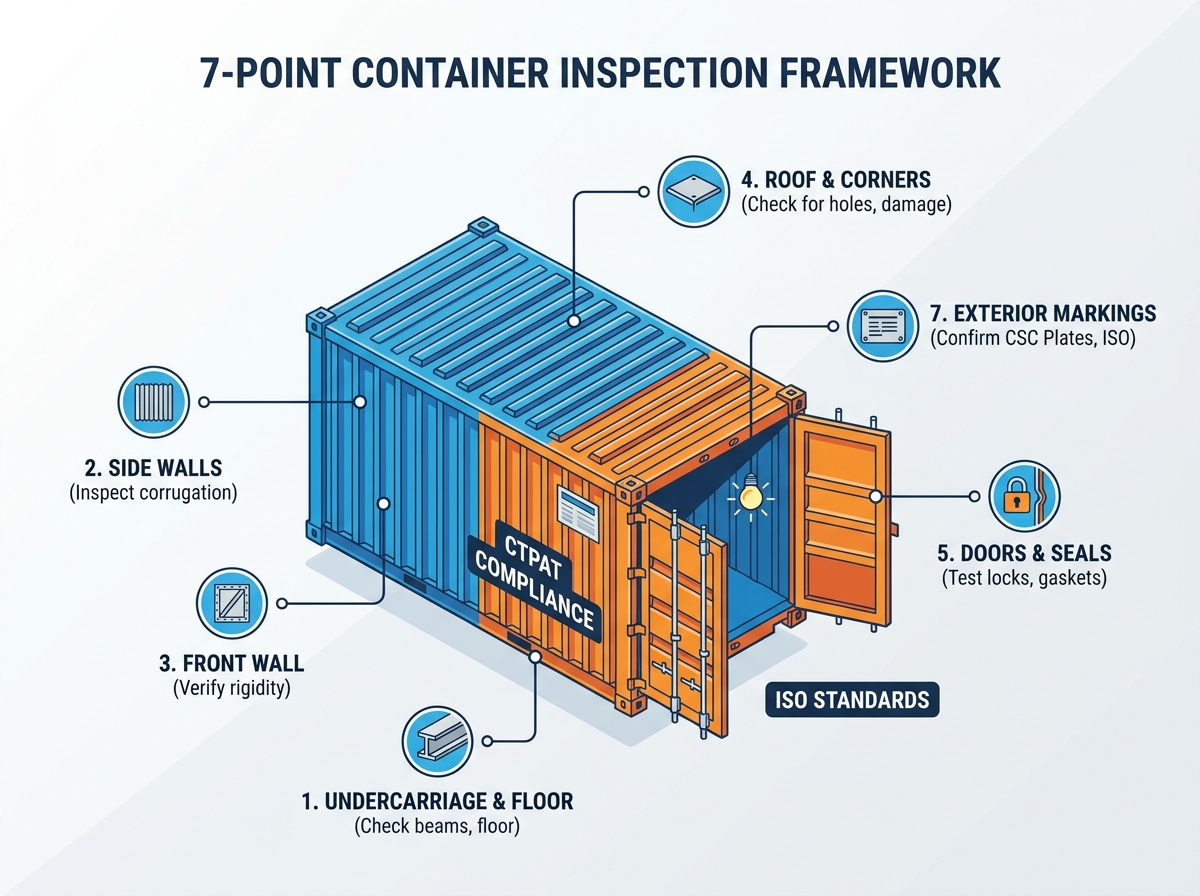
Effective bulk inspection requires adopting the CTPAT 7-point structural framework to systematically identify critical failures in roofing, undercarriage, and door seals.
For bulk orders, mandate independent, third-party marine surveyor reports rather than relying on in-house depot assessments.
Bulk buyers often face misaligned expectations regarding used inventory conditions. You might gladly accept visual wear during procurement. However, structural compromise remains completely unacceptable. We must categorize assets accurately before deployment. Without a shared vocabulary, buyers and sellers frequently clash over quality standards.
Best Practice: Always request a written definition of the vendor’s grading criteria before initiating a bulk order. It prevents costly misunderstandings down the line.
Grading Framework Comparison
Grade Level | Functional Status | Intermodal Certification | Recommended Use Case |
|---|---|---|---|
As-Is / Non-Standard | High risk, requires extensive refurbishment. | None. Fails legal transit standards. | Scrap, rebuilding projects, or strict raw material salvage. Not recommended for logistics. |
Wind and Water Tight (WWT) | Functional for static storage. Prevents weather ingress. | Lacks active certification for rail or ocean transport. | On-site agricultural storage or static inventory holding. |
Cargo Worthy (CW) | Structurally sound. Aesthetic condition varies heavily. | Yes. Certified for international marine transport. | Standard global export, intermodal logistics, and freight forwarding. |
IICL standard | Exceptional condition. Minimal repair needs. | Exceeds standard requirements. Strictest global certification. | Long-term corporate leasing, high-value sensitive cargo transit. |
You must implement a strict decision filter before inspecting units. Align your target grade directly with your end-use case. You want to avoid overpaying for aesthetic perfection if you only need static storage. Conversely, underpaying for compromised assets guarantees disastrous delays during ocean transit. Clarify these boundaries early in the procurement cycle.
Effective bulk evaluation requires removing subjectivity entirely. We recommend leveraging the standardized CTPAT (Customs Trade Partnership Against Terrorism) 7-point inspection method. It provides a highly systematic framework. Procurement teams use it to standardize condition reporting across diverse depot locations.
The undercarriage bears the massive stress of heavy cargo. You must check for cross-member deflection. Look closely for severe rust scaling along the structural beams. Next, evaluate the interior flooring. You must watch for severe flooring delamination. The marine-grade plywood must remain intact. Ensure there are no unidentifiable chemical spills. Deep gouges compromise load bearing capacity and risk contaminating your future cargo.
Side walls provide crucial stacking strength. Inspect the Corten steel corrugation carefully. You must look for deep dents exceeding acceptable ISO tolerances. Such dents severely weaken the vertical integrity of the unit. Additionally, identify any poorly welded patches. They strongly indicate previous severe trauma. Inadequate repairs will fail under heavy lateral transit forces.
The front wall sits behind the truck cabin during road transport. It frequently suffers damage from hard braking. You need to verify its structural rigidity. Look for obvious bowing or metal stretching. If the front wall pushes outward, it indicates a compromised frame. Such deformities make intermodal loading highly dangerous.
Implementation reality dictates a significant challenge here. Roofs remain incredibly difficult to inspect when stacked high in port depots. However, you must require ground-level inspection for your bulk samples. Check the top panels for pinholes. Look for pooling water damage indicating sunken sections. Finally, verify that all upper corner castings remain completely uncompromised.
Defective doors destroy operational efficiency immediately. You must physically test the locking mechanisms. Verify the cam keepers, hinges, and lock boxes move smoothly. Inspect the perimeter rubber gaskets extensively. Look for dry rot or severe tearing. Compromised gaskets serve as the leading cause of catastrophic water ingress during ocean voyages.
Common Mistake: Buyers often visually inspect doors without physically opening them. You must feel the resistance of the hinges to identify bent door frames.
We rely heavily on the simple "Daylight Test" to verify interior seals. Step inside the unit. Close both doors securely behind you. Wait a moment for your eyes to adjust. Look for any light leaks piercing through the seams or roof. Furthermore, check the inner walls for severe condensation damage. Pervasive mold indicates chronic moisture retention issues.
Exterior compliance ensures safe terminal handling. Verify the printed weight decals match the structural build plates exactly. Discrepancies cause severe delays at weigh stations. Confirm the bottom and top corner castings remain completely free of hairline cracks. Safe crane handling demands flawless corner castings.
A physical asset remains completely useless if it cannot legally enter intermodal transit. Evaluating structural integrity is only half the battle. You must strictly enforce compliance verification. Global port authorities demand specific regulatory markings. Without them, terminals will reject your assets immediately.
You must begin with CSC (Container Safety Convention) plate verification. The plate must remain securely affixed to the left door of the unit. It serves as the official passport for the asset. You must read it carefully. It must detail the exact date of manufacture. It must display the unique identification number clearly. Furthermore, it must specify the maximum gross weight and allowable stacking weight.
Locate the CSC plate on the lower portion of the left door.
Verify the identification number matches the painted decals on the exterior walls.
Check for valid ACEP (Approved Continuous Examination Program) stickers.
Alternatively, look for a valid PES (Periodic Examination Scheme) date stamp.
You face immediate risk if these markings fail scrutiny. A missing CSC plate demands an instant rejection. A heavily altered or illegible plate on a supposedly "Cargo Worthy" unit acts as a massive red flag. We strongly advise you to reject that unit entirely. Proceeding without proper ISO markings invites severe legal and logistical penalties.
Demonstrating trustworthiness in procurement requires realistic expectations. We acknowledge older used units inevitably feature rust and dents. They face harsh marine environments daily. Your core goal is differentiating harmless cosmetic issues from fatal structural death sentences. You must not panic over superficial blemishes.
We classify several visual defects as completely acceptable deficiencies. Surface oxidation on Corten steel acts as a protective patina. It prevents deeper corrosion. You will often find minor floor scratches from forklift traffic. We also consider superficial dents on wall panels normal wear and tear. They do not impact the core structural grid.
Conversely, you must recognize absolute deal-breakers. Reject these units instantly during your bulk evaluations:
Cancerous Rust: This rust flakes off heavily in your hands. It causes structural degradation directly at the core welds.
Bent Corner Posts: The four corner posts handle all stacking weight. A cracked or bent post proves fatal to stacking integrity.
Racked Frames: Doors requiring heavy machinery or excessive physical force to close indicate a twisted frame. The unit is structurally dead.
Implementation realities present significant logistical challenges for large buyers. You cannot personally inspect 100 units spread across three different port depots. Time constraints and geographical barriers prevent manual verification. You need a highly systematic solution approach to scale your quality control.
First, adopt strict sampling logic. We recommend you personally inspect a 10-20% random sample of the allocated fleet. Do not let the vendor select the sample units. Choose them randomly from the provided inventory list. This prevents vendors from hiding degraded assets at the back of the depot.
Next, you must rely on independent professionals. Hire an accredited marine surveyor to conduct independent condition reporting. They provide unbiased, legally binding documentation. Their expertise removes the emotional friction from vendor negotiations.
Finally, build strict contractual protections into your agreements. Bake rejection clauses directly into the bulk purchase contract. Tie these clauses directly to the independent surveyor’s findings. Request sample inspection reports from short-listed vendors before negotiating terms. This gauges their overall transparency. If they hesitate to share past reports, you should walk away.
Best Practice: Always specify the exact acceptable repair standards (like IICL) in your RFP (Request for Proposal). It eliminates ambiguity before pricing discussions begin.
Implementing a rigorous quality inspection checklist transforms a risky capital expenditure into a highly predictable procurement process. You eliminate the guesswork from bulk fleet acquisitions. By enforcing the 7-point CTPAT framework, you protect your supply chain from cascading logistical failures. You secure assets that perform reliably under severe intermodal stress.
We strongly recommend you never waive the right to a third-party survey on bulk orders. Do not ignore this rule, regardless of the vendor's stellar reputation or promised cost savings. Objective verification remains your strongest defense against procurement disasters. If you need clarification on these survey requirements, feel free to contact us directly.
Take immediate action today. Download and utilize a formalized inspection checklist when requesting initial RFPs from suppliers. Force vendors to acknowledge your quality standards in writing. This proactive strategy guarantees you acquire safe, compliant, and highly functional maritime assets.
A: Typically, the buyer assumes responsibility for this expense. However, you can negotiate it in bulk deals as a condition of sale. Vendors occasionally absorb the surveyor fee to finalize massive contracts. We recommend clarifying this payment structure during your initial RFP phase.
A: A standard CW survey report remains valid for 12 to 24 months. The exact duration depends entirely on the specific examination scheme utilized (ACEP or PES). You must verify the expiration date on the CSC plate before accepting the asset for long-term ocean transit.
A: Yes, it is physically possible. However, it requires a certified surveyor to assess the damage deeply. You must execute repairs matching strict ISO standards and issue a brand-new CSC certification. This complex process is rarely cost-effective for bulk buyers seeking immediate deployment.
A: Surface rust forms a thin, protective patina over Corten steel, preventing further decay. It remains entirely cosmetic. Structural rust acts aggressively. It flakes off in large chunks, reduces the overall metal thickness, and severely compromises the unit's load-bearing capacity.


