


Views: 0 Author: Site Editor Publish Time: 2026-07-28 Origin: Site


China dominates global production. It manufactures over 80% of all shipping containers worldwide. However, identifying a reliable factory remains a high-stakes challenge. Thousands of trading companies and agents crowd the market. Purchasing at scale involves significant capital risk. You also face compliance hurdles like CSC certification. Export logistics add another layer of complexity. You cannot afford blind decisions when procuring heavy industrial assets. A wrong choice leads to delayed shipments. It compromises steel quality and wastes capital. This guide strips away marketing noise. It provides a strictly operational framework. We designed it to help you evaluate, shortlist, and secure a direct shipping container manufacturer in China. We will cover how to verify real factories. You will understand standard material specifications. We will also show you how to manage inland logistics seamlessly. By the end, you will know how to navigate procurement safely.
Verifying a direct manufacturer requires auditing their production capacity, Corten steel sourcing, and international classification society certifications (e.g., ABS, BV, GL).
Purchasing Shipper Owned Containers (SOC) directly from a Chinese factory can significantly reduce long-term freight and demurrage costs if structured correctly.
The lowest quote often hides compromises in steel grade, paint thickness (microns), or inland logistics support.
Successful sourcing requires aligning factory production lead times with your freight forwarder’s consolidation and loading schedules.
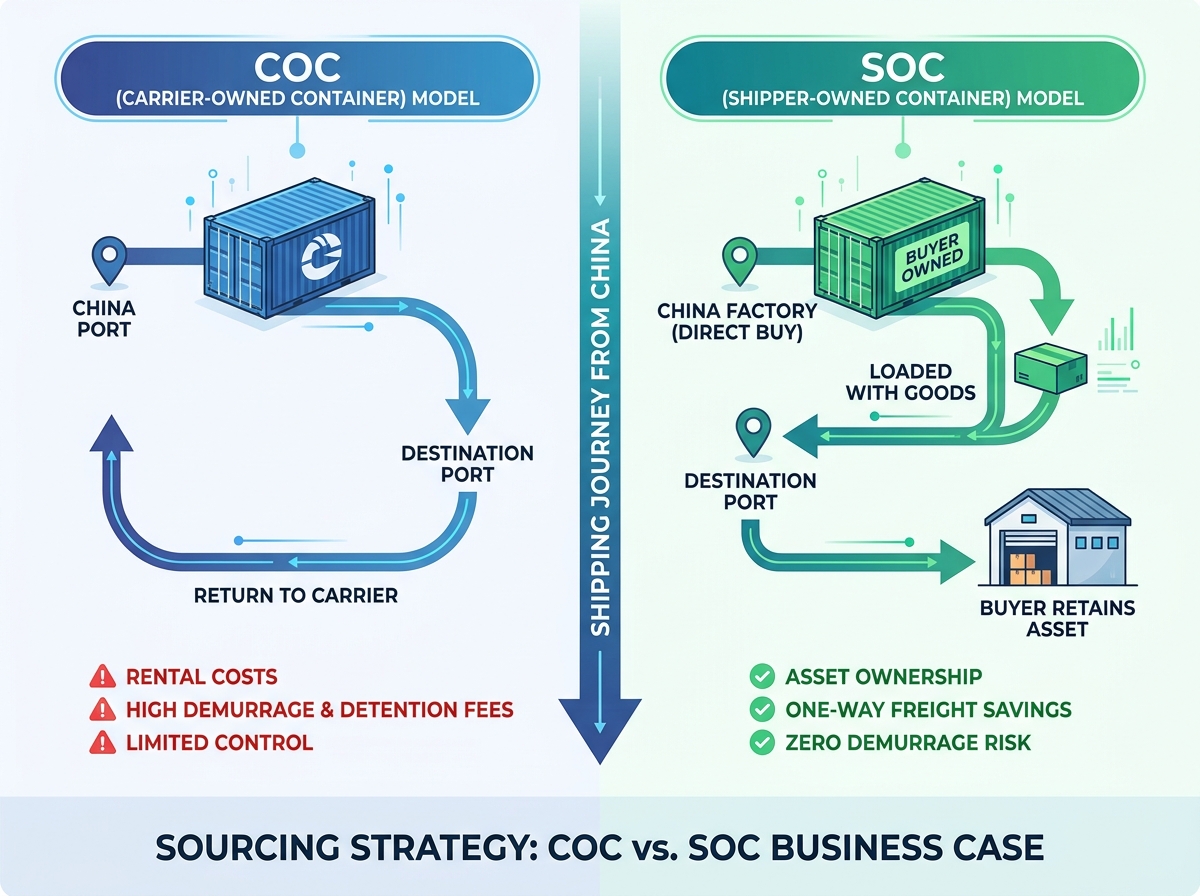
Many buyers wonder when direct procurement makes sense. You must evaluate the financial threshold carefully. Buying direct becomes highly profitable under specific conditions. We call this the Shipper Owned Container (SOC) advantage. Owning your equipment eliminates expensive carrier rental fees. You gain complete control over your shipping timeline.
Consider the one-way use strategy. You purchase empty units directly from the factory. You load them with sourced goods across China. Next, you ship them as a Full Container Load (FCL). You retain the physical asset upon arrival at the destination. You can then resell it or use it for local storage. This strategy effectively subsidizes your initial purchase cost.
Demurrage and detention fees severely damage profit margins. Supply chain bottlenecks often trap carrier-owned containers at ports. Carriers charge daily penalties for these delays. Owning the asset eliminates port storage penalties entirely. You bypass these unexpected expenses completely. The return on investment becomes obvious during port congestion.
However, you must consider volume thresholds. Direct factory procurement requires certain minimums. Most factories enforce Minimum Order Quantities (MOQs). These usually range from 10 to 50 units. Local secondary markets suit single-unit buyers better. You should only approach factories when buying at scale. We outline these differences below.
Operational Comparison: SOC vs. COC
Feature | Shipper Owned Container (SOC) | Carrier-Owned Container (COC) |
|---|---|---|
Asset Ownership | Buyer owns the unit | Shipping line owns the unit |
Demurrage Fees | Zero port penalties | High daily charges |
Logistics Control | High flexibility | Strict return deadlines |
The intermediary trap catches many overseas buyers. B2B portals list thousands of apparent suppliers. Most of these profiles belong to middlemen. Trading companies add unnecessary markups to the base price. They also exercise zero control over quality assurance. You need a direct shipping container manufacturer to ensure compliance.
Verification requires strict document reviews. You must request the official Business License. Examine the "Scope of Business" section closely. It must explicitly state manufacturing or production. Reject companies listing only trade or export services. You should also demand their ISO 9001:2015 certification. Ensure the certificate address matches the actual factory location exactly.
A true factory footprint is massive and unmistakable. Container production requires heavy industrial infrastructure. Real facilities operate heavy-duty press machines for steel corrugation. They utilize extensive automated welding lines. A small workshop simply cannot manufacture marine-grade units. You can verify this scale through strategic audits.
Third-party audits remain absolutely essential. You must hire independent local inspectors before signing contracts. Companies like SGS or TÜV provide excellent factory audit services. Instruct them to conduct unannounced visits. They will verify machinery, workforce size, and production capacity.
Here are the critical documents to request:
Official Chinese Business License explicitly stating manufacturing.
ISO 9001:2015 Quality Management Certificate mapped to the facility address.
Export License registered with China Customs.
Recent Mill Test Certificates (MTC) proving raw material sourcing.
Shortlisting suppliers requires strict technical evaluation. You cannot rely on visual appearances alone. Material specifications dictate the lifespan of your units. You must mandate Corten A (SPA-H) weathering steel. This specific marine-grade steel resists harsh saltwater environments. Demand to see the Mill Test Certificates (MTC). These documents trace the steel back to major mills like Baosteel.
Compliance ensures global transport legality. Every unit requires an International Convention for Safe Containers (CSC) plate. You must verify the factory holds authorization to affix CSC Safety Approval Plates. Port authorities will reject units lacking proper CSC certification.
Classification society approvals provide another layer of trust. Do not accept self-certified documents. Check for batch certifications from globally recognized bodies. Look for Bureau Veritas (BV), Lloyd's Register (LR), or the American Bureau of Shipping (ABS). These societies validate the structural integrity of the design.
Paint and coating standards prevent premature corrosion. Evaluate the factory's standard marine-grade painting processes. They must apply a high-quality zinc-rich primer. Measure the topcoat thickness carefully. Industry standards dictate specific micron levels for each layer. Skimping on paint thickness represents a common cost-cutting tactic.
Finally, assess their customization capabilities. You might need specific modifications for your cargo. Factories should handle extra vents or custom RAL colors easily. They should install lock boxes or build high-cube variations upon request. A capable facility integrates these modifications without delaying standard production lines.
Follow these sequential steps during your supplier evaluation:
Verify Corten A steel procurement via certified MTCs.
Confirm CSC plate authorization and review past batch records.
Request documentation from major marine classification societies.
Audit the paint booth for zinc-primer application and micron testing.
Test the engineering team's response time for custom modification requests.
Manufacturing the unit only solves half the puzzle. You must transport it out of China efficiently. Inland transportation capabilities vary wildly among factories. Ask if they possess a dedicated logistics network. They must deliver empty units to major export hubs reliably. Key ports include Shanghai, Ningbo, Shenzhen, and Qingdao. A factory lacking inland transport contacts will cause severe delays.
Many buyers face complex cross-province consolidation challenges. You likely purchase goods from multiple suppliers across China. You need a centralized consolidation warehouse. Factories send your newly purchased empty box to this warehouse. Your suppliers then route their goods to the same location. Workers load all the cargo into your unit. This process requires precise scheduling and excellent communication.
Customs clearance requires careful handling. Exporting a brand-new box presents unique documentation challenges. You must declare the container as a product itself. However, you also use it as packaging for other goods. Your customs broker must file dual declarations correctly. Errors here trigger immediate port holds and inspection fees.
Incoterms selection dictates your financial risk during transit. We strongly recommend FOB (Free on Board) or FCA (Free Carrier). These terms place inland transport responsibility on the factory. They handle terminal delivery and initial export clearance. You assume control only after the unit clears the rail or terminal.
Recommended Incoterms for Factory Direct Purchases
Incoterm | Factory Responsibility | Buyer Responsibility |
|---|---|---|
FCA (Free Carrier) | Delivery to designated terminal/warehouse | Main carriage and import clearance |
FOB (Free on Board) | Loading onto the export vessel | Ocean freight and destination charges |
Procurement risks multiply when buying overseas. You must identify red flags early. The "bait and switch" tactic happens frequently. A factory shows high-grade Corten steel during your initial inspection. However, they substitute standard carbon steel during actual production. Carbon steel rusts rapidly in marine environments. Continuous third-party material testing prevents this deception.
Unrealistic lead times should trigger immediate suspicion. Standard production requires careful scheduling. Peak manufacturing seasons cause massive factory backlogs. This happens especially right before the Chinese New Year. A factory promising ultra-fast delivery during peak times is likely lying. They often outsource your order to unvetted sub-contractors. This destroys any quality control guarantees.
Review the warranty terms meticulously. Standard industry warranties cover five years for paint degradation. They also provide one year for decals and door hardware. Reject any shipping container manufacturer refusing to document these procedures explicitly. Vague promises mean nothing when a door seal fails in transit.
Opaque pricing structures hide significant financial traps. A remarkably low initial quote rarely reflects the final invoice. Factories often conceal fees for CSC certification issuance. They might exclude inland drayage or port handling charges. Demand a fully itemized proforma invoice before sending any deposit. Transparency is non-negotiable.
Sourcing directly from a China shipping container manufacturer is a high-yield strategy if executed with rigorous due diligence. You can bypass middlemen, eliminate rental fees, and secure marine-grade assets for long-term use. However, success depends entirely on verification and logistics planning. Never skip independent audits or accept vague material specifications.
Take action by defining your exact technical specifications first. Next, request detailed RFQs (Request for Quotation) from a shortlist of three to five verified factories. Finally, mandate a third-party factory audit before issuing any deposit. These precise steps will protect your capital and streamline your supply chain.
A: Most true manufacturers have Minimum Order Quantities (MOQs) ranging from 10 to 50 units. For single units, buyers usually deal with trading companies or buy from local depot stock.
A: Standard production takes 20-45 days depending on factory backlog. Shipping adds 15-40 days depending on the destination port and current vessel schedules.
A: You must secure the container's CSC certificate, provide the container number to your freight forwarder, book an SOC slot on a vessel, and arrange for your suppliers to load their cargo into it before returning it to the port terminal.
A: Demand the Mill Test Certificate (MTC) from the steel factory (e.g., Baosteel) and hire a third-party inspector to conduct material testing during the production run.


