


Views: 0 Author: Site Editor Publish Time: 2026-08-07 Origin: Site


Procuring shipping containers directly from the source often reveals a complex, fluctuating pricing landscape. Logistics and procurement teams frequently face massive hurdles here. You simply cannot rely on static quotes. Quotes from a shipping container manufacturer change constantly. They respond rapidly to a matrix of raw material costs, global trade flows, and hidden logistical fees. Buyers often encounter unexpected budget overruns because they misunderstand these shifting elements. Understanding the underlying variables of container pricing solves this problem completely. It allows buyers to evaluate quotes accurately. You can time your procurement cycles effectively. It also helps you avoid unpredictable downstream surcharges. We will break down exactly what drives these baseline costs. You will learn how to analyze structural specifications and macroeconomic shifts. This guides your purchasing strategy toward better efficiency, transparency, and operational success.
Base prices are fundamentally tied to the commodities market, specifically Corten steel and manufacturing location labor rates.
Physical specifications (size, specialty types, and modifications) create baseline price tiers, while market conditions dictate actual availability.
Macroeconomic volatility, including global trade imbalances and port congestion, heavily skews the final delivered cost of containers.
Evaluating a manufacturer requires looking beyond the "factory-gate" price to account for repositioning, delivery, and compliance costs.
Shipping containers function essentially as raw commodities. The global price of Corten steel dictates the primary manufacturing cost. Corten is a specialized weathering steel. It contains specific alloys like copper, chromium, and nickel. These elements create a rust-like appearance on the surface. They stop deeper corrosion dead in its tracks. This material accounts for the vast majority of the unit's weight. Steel mills operate on very tight margins. Any disruption in global iron ore mining shifts prices immediately. You must monitor these commodity indices closely. They offer early warnings for upcoming price hikes. Manufacturers routinely pass these material cost increases directly to buyers. Over 90% of global container manufacturing happens in Asia. China currently dominates this entire sector. Geographic concentration means local economic conditions heavily influence your final quote. Factory energy rates fluctuate seasonally based on local grid demands. Regional labor wages continue to rise year over year. Environmental regulations also play a massive role. Local governments sometimes mandate strict emissions controls. Factories must upgrade their equipment to comply. They bake these compliance costs into every unit they build. You pay for these regional regulatory shifts. Economies of scale dictate factory floors. Facilities optimize their assembly lines for massive, continuous production runs. Producing thousands of identical units minimizes downtime. Bulk orders naturally secure lower per-unit costs. Smaller procurement batches disrupt these streamlined operations. Factories must halt their lines and recalibrate heavy machinery. This interruption incurs premium pricing. Retail buyers or small fleet operators pay higher unit prices because of this inefficiency. You must understand your required volume before negotiating. Consolidating your orders can save you significant capital.
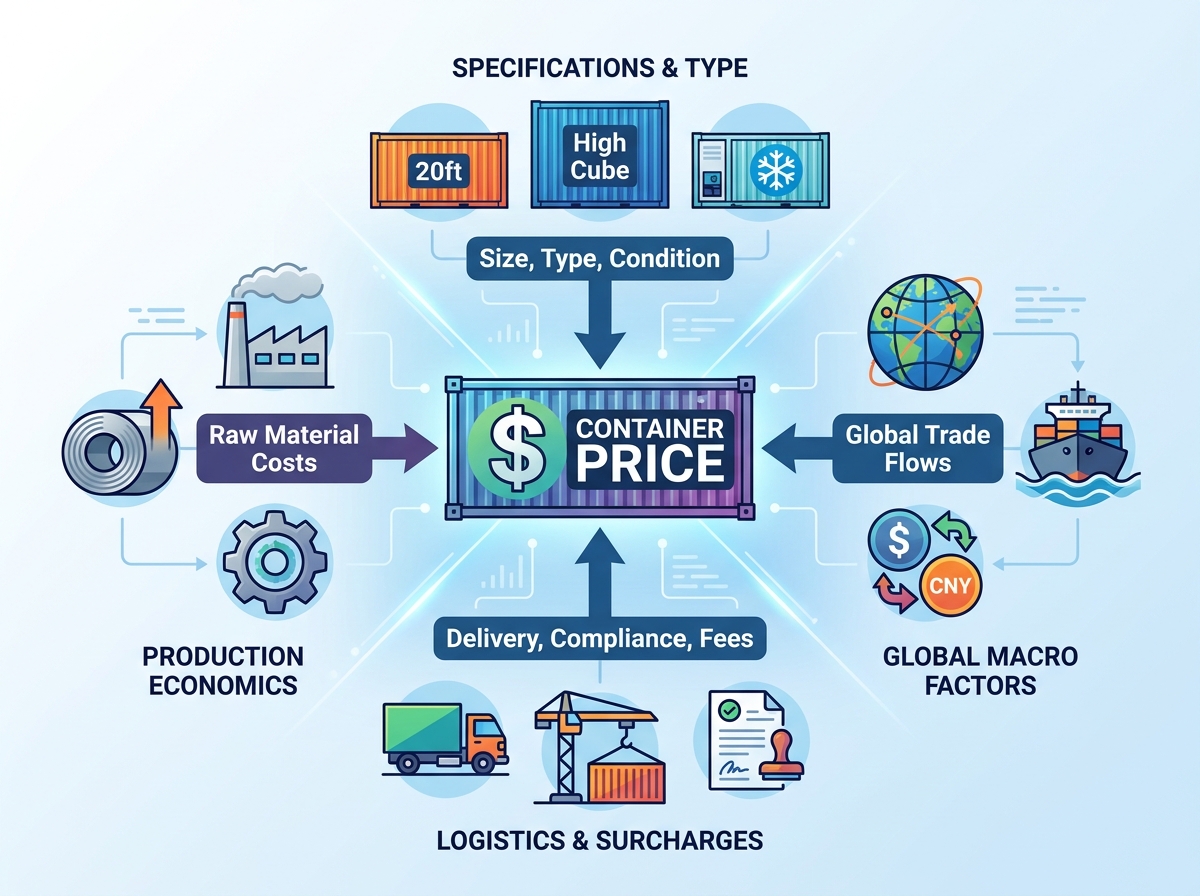
Standard units dominate the global market. The 20ft and 40ft footprints serve as universal logistical currencies. High Cube variants add an extra foot of vertical height. Standard boxes measure 8ft 6in tall. High Cubes measure 9ft 6in tall. This extra vertical space accommodates voluminous, lighter cargo easily. However, it requires more corrugated steel panels. It also needs reinforced structural pillars. Factories always charge a premium for this extra material and engineering effort. You must calculate if the extra cargo capacity justifies the higher purchase price. Specialized units demand severe cost premiums. They require intense engineering modifications. Reefer containers need active cooling components (gensets). They require thick insulation panels and specialized airflow flooring. Open-top containers require removable tarps and movable roof bows. Flat racks need incredibly heavy-duty bases to support oversized, awkward cargo. Dangerous goods containers require specialized ventilation and spill-containment floors. These complex physical specifications push units into much higher baseline price tiers. A brand-new empty box creates a logistical problem. Shipping it empty across the ocean wastes money. The shipping industry hates moving dead air. Manufacturers solve this through the "one-trip" leasing model. They partner directly with global logistics firms. They load the newly built container with commercial cargo. The container makes its maiden voyage to your region. Once it arrives, port workers unload the cargo. The vendor then hands the container to you. This strategy offsets massive repositioning costs. It keeps your final purchase price reasonable. You receive a pristine container without paying empty ocean freight fees.
Specification Category | Key Structural Additions | Market Pricing Impact Level |
|---|---|---|
Standard Units (20ft/40ft) | Basic Corten steel shell, standard flooring | Baseline Market Rate |
High Cube Upgrades | Extra vertical panels, reinforced pillars | Moderate Premium (10-15%) |
Open-Top Designs | Removable roof bows, heavy-duty tarps | Moderate to High Premium |
Reefer Units | Gensets, thick insulation, active airflow floors | Extreme Premium (300%+) |
Structural trade imbalances shape the pricing landscape entirely. Regions often export far more goods than they import. For example, massive volumes of goods leave Asia daily. Far fewer goods return on those same ships. This dynamic creates localized container shortages at major export hubs. At the exact same time, import-heavy regions accumulate mountains of empty boxes. A shipping container manufacturer increases prices when outbound demand heavily outpaces supply. They know logistics companies will pay premiums to secure export capacity quickly. Geopolitical disruptions alter pricing overnight. Sudden supply chain shocks change the available inventory completely. We often see vessels rerouting around major canals due to conflict. Port strikes halt vessel movements entirely. These events create severe ripple effects across the entire industry.
Ocean transit times increase significantly as ships take longer routes.
Available shipping capacity drops almost overnight across the globe.
Logistics providers panic-buy new units to compensate for delayed cycles.
Factory order books fill up months in advance due to demand spikes.
Baseline procurement prices inflate artificially and stay high.
You must watch global news closely. A strike on one continent affects factory prices on another. Currency fluctuations matter immensely. Most factories operate physically in China. They pay their workforce, energy bills, and domestic suppliers in RMB (Chinese Yuan). However, they quote international buyers strictly in USD. You must watch the exchange rate closely. A strong US Dollar against the RMB lowers your effective cost. A weak US Dollar makes the exact same container more expensive. Buyers who time their purchases alongside favorable currency shifts save substantial amounts of money.
The Ex-Works (EXW) price looks incredibly appealing on paper. Do not let it fool you. This is simply the "factory-gate" price. It excludes all transport away from the manufacturing facility. Buyers must calculate the actual landed cost to avoid surprises. Cheap initial quotes almost always hide missing logistical steps. You must pay for inland transport to the outbound port. You must pay ocean freight. You must pay terminal fees. Always compare Delivered at Place (DAP) or total landed quotes rather than isolated factory prices. Regulatory compliance remains strictly non-negotiable. Every shipping unit requires Container Safety Convention (CSC) plating. This brass plate proves the box can withstand brutal marine transport. Facilities must perform rigorous quality assurance testing before issuing it. They test floor strength under heavy loads. They test stacking capacity. They test structural integrity against lateral forces. Legitimate manufacturers bake these testing costs directly into their quotes. Unusually low prices should trigger an immediate warning. The vendor might skip crucial certifications. Port authorities will reject uncertified boxes immediately. Localized fees add up incredibly quickly. You face several inevitable charges once the box reaches your shore.
Terminal Handling Charges (THC) at both the origin and destination ports.
Customs clearance documentation fees and import duties.
Inland drayage charges for final site delivery via truck or rail.
Demurrage and storage fees if delays occur at the terminal.
Buyers must factor every single one of these line items into their total acquisition budget. Ignoring them ruins procurement forecasts entirely.
Standardize your Request for Proposal (RFP) immediately. You need a completely level playing field. Detail your exact structural specifications. Specify the exact grade of Corten steel. Demand specific marine paint micron thickness. State your expected delivery timeline clearly. Demand all required certifications upfront. This prevents vendors from cutting corners on quality. Unscrupulous sellers might quote low by using inferior floorboards. They might apply thinner coats of paint. Standardized criteria expose these tricks quickly. It ensures you compare vendors accurately. Interrogate the surcharge breakdown relentlessly. Treat "all-in" pricing with healthy skepticism. Ask vendors for a heavily itemized list. Separate the raw unit cost from the logistics. Isolate handling and warranty fees clearly. This transparency reveals the true value of the offer. Some vendors inflate inland drayage costs to subsidize a artificially low unit price. You can only spot these games if you demand itemization. Do not accept vague invoice lines. You have the right to know exactly what you are paying for. Assess the vendor's financial solvency and track record. Volatile markets routinely bankrupt fragile brokers. You need an established, robust partner. A reliable shipping container manufacturer guarantees delivery schedules. They honor their long-term warranties without arguing. They survive macroeconomic downturns. Look into their production history. Ask for references from large logistics firms. Mitigate your risk of non-performance by choosing partners with proven resilience. A slightly higher upfront cost is worth the peace of mind.
The cost of a shipping container functions as a living metric. It remains deeply tied to global economics, raw steel markets, and shifting logistics networks. You cannot treat it like a static retail product. Base materials, structural specifications, and hidden port fees govern the final invoice. You must account for trade imbalances and currency volatility. Shift your strategy away from seeking the absolute cheapest box. Find a transparent manufacturing partner instead. Review your upcoming procurement volume early. Consolidate your orders to leverage economies of scale. Start forecasting your needs based on current supply chain indices. By understanding the true drivers of cost, you protect your budget and streamline your global operations.
A: The global shipping industry uses the US Dollar as its standard reserve currency. International commodities, including Corten steel, trade primarily in USD. Pricing containers in dollars stabilizes cross-border transactions. It provides a universal benchmark for logistics companies, leasing firms, and manufacturers worldwide, simplifying international trade agreements.
A: Volume discounts vary based on factory capacity and raw material costs. Bulk orders often yield a 5% to 15% discount compared to single-unit retail purchases. Buying hundreds of units allows factories to optimize assembly lines. Small procurement batches disrupt these lines and naturally carry premium markups.
A: It depends strictly on the quoted terms. Many manufacturers quote Ex-Works (EXW) or Free on Board (FOB) prices. These terms cover only the factory gate or the outbound port. Door-to-door delivery requires a specific Delivered at Place (DAP) agreement. Always request a clear breakdown of logistics fees.
A: Prices in 2025 remain highly sensitive to macroeconomic shifts. Global supply chains continue to face intermittent disruptions. Freight route adjustments and shifting trade imbalances keep baseline costs volatile. Industry indices suggest moderate stabilization, but localized shortages can still trigger sudden price spikes for new equipment.


