


Views: 0 Author: Site Editor Publish Time: 2026-07-20 Origin: Site


Commercial construction is undergoing a massive shift as traditional timelines become harder to manage. Developers are increasingly turning to container-based modular buildings for their impressive resilience, sustainability, and overall efficiency. However, repurposing these massive steel shipping containers requires highly specialized engineering knowledge. Standard modular builders often lack the deep expertise needed to maintain proper structural integrity once a container is cut or modified. A wrong choice in fabrication partners can lead to costly delays, failed inspections, and unsafe buildings. This guide sets out to solve that specific problem. We provide a strictly objective, developer-focused framework for your procurement process. You will discover exactly how to evaluate, shortlist, and select a highly credible shipping container manufacturer for your next commercial development.
Engineering First: A reliable manufacturer must provide stamped structural engineering plans, not just floor plan sketches.
Compliance is Mandatory: Vendor selection must be tied to their proven ability to navigate local building codes and industry standards (e.g., MBI guidelines).
Scalability Matters: For multi-unit developments, a manufacturer’s capability to support phased installations and guarantee supply chain consistency is a non-negotiable evaluation metric.
Container-based building is vastly different from traditional stick-built modular construction. Standard modular units typically use heavy timber or light-gauge steel frames. Conversely, shipping containers act as monocoque structures. They rely entirely on their corrugated Corten steel walls to carry heavy structural loads. You cannot treat them like standard framing.
When you cut a container to install large windows, doors, or join multiple units together, you instantly compromise its structural integrity. You must reinforce the cut areas with precise tubular steel framing. Without proper engineering, the roof could sag. In worst-case scenarios, the entire unit could collapse under heavy snow loads or high winds.
This reality exposes a massive gap in the vendor market. You must clearly differentiate between a standard "container modifier" and a true commercial-grade manufacturer. A basic modifier might excel at building a single pop-up coffee shop or a backyard shed. They often operate out of small local yards. They rarely employ full-time structural engineers.
A commercial-grade manufacturer operates very differently. They deliver multi-story, code-compliant modular buildings at scale. They utilize advanced fabrication facilities. They employ rigorous quality control systems. A successful partnership hinges completely on a manufacturer's ability to balance your architectural flexibility with rigorous structural safety. They must turn your vision into a legally compliant, structurally sound reality.
Vendor Capability Comparison
Feature | Basic Container Modifier | Commercial Manufacturer |
|---|---|---|
Primary Focus | Pop-up shops, single-unit offices | Multi-story commercial, multi-unit residential |
Engineering Staff | Often outsourced or non-existent | In-house structural and MEP engineers |
Code Compliance | Leaves local permitting to buyer | Designs to specific state/federal building codes |
Facility Type | Small yard or outdoor lot | Climate-controlled, assembly-line factory |
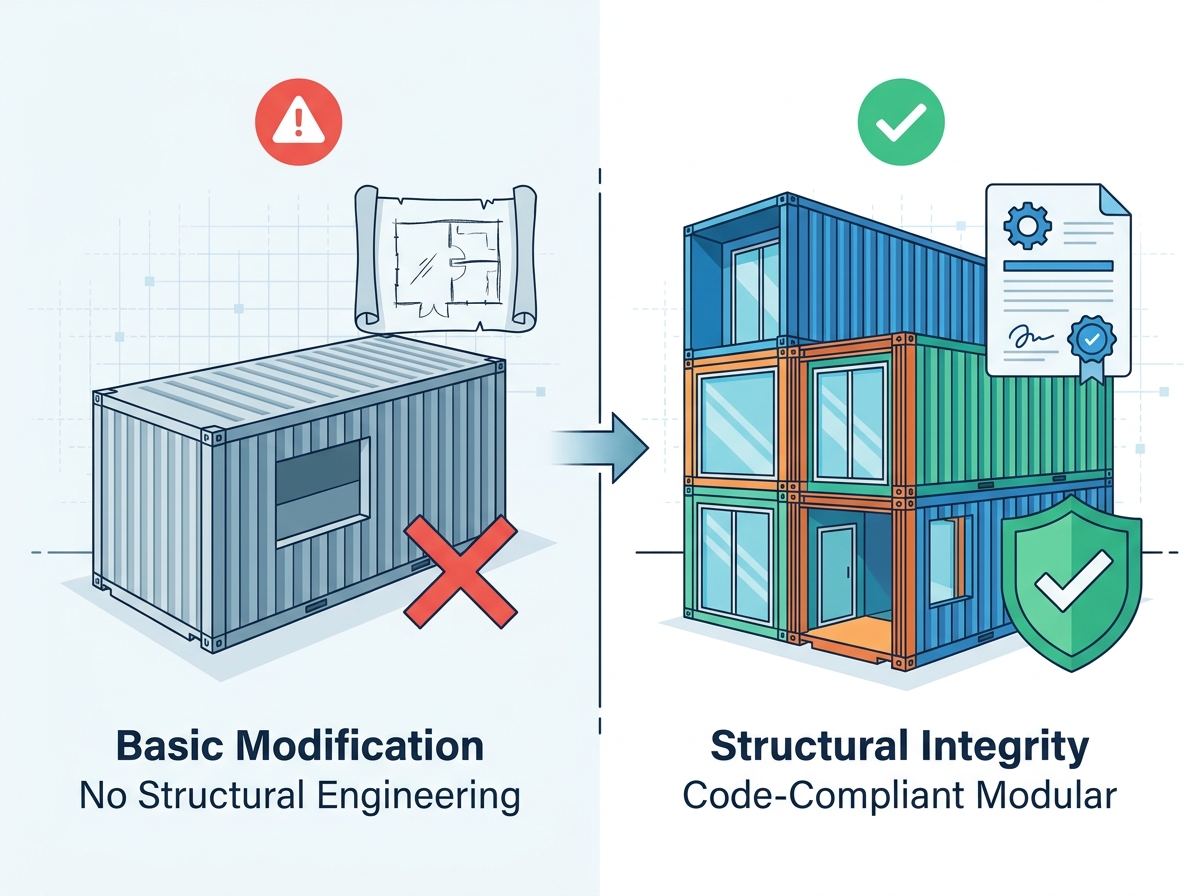
You cannot rely on simple floor plan sketches for commercial projects. Your chosen partner must provide comprehensive structural load calculations. These calculations must account for local wind speeds, seismic activity, and roof snow loads. They must also perform detailed energy modeling to ensure the steel enclosures meet strict efficiency standards.
MEP (Mechanical, Electrical, Plumbing) integration is uniquely challenging in steel boxes. Engineers must route utilities through corrugated walls without compromising strength or insulation. Demand transparent, upfront collaboration between the factory's engineers and your site architects. This open communication is a massive trust signal. It ensures your design is actually feasible before anyone cuts into a steel box.
Modular building codes are notoriously complex. Your units must adhere strictly to local, state, and federal building codes. For example, steel is an excellent conductor of heat and cold. Your partner must understand proper insulation requirements for your specific climate zone. They must know when to apply closed-cell spray foam to prevent internal condensation.
Fire ratings present another major hurdle. Multi-unit buildings require specific fire separation assemblies between modules. The factory must properly install and certify these fire-rated barriers. Mentioning alignment with recognized industry authorities serves as a strong benchmark. Look for active participation in the Modular Building Institute (MBI). This alignment demonstrates a commitment to credibility, ongoing safety education, and standardized practices.
The debate between "One-Trip" and "Used" containers is critical. One-trip containers are manufactured overseas, make a single cargo journey, and then go directly to the modification facility. They are virtually brand new. Used containers might have spent a decade at sea. They often feature deep structural rust, major dents, and potentially hazardous chemical spill histories.
Demand absolute transparency regarding container history. If you opt for used boxes, the factory must detail their rust mitigation protocols. They must also explain how they safely remove toxic marine-grade floor paint. You should look for a shipping container manufacturer that guarantees precision welding. They must maintain strict factory-controlled quality assurance (QA) processes before shipping any unit to your site.
Developers scaling large projects face unique logistical pressures. You must rigorously evaluate the manufacturer’s actual factory throughput. Ask hard questions about their facility size. Can they build twenty units simultaneously? More importantly, can they physically store completed units if your site preparation faces weather delays?
Phased installations require precise coordination. A capable facility will sequence deliveries to perfectly align with your complex site-prep schedules. They stage the modules so the ground crew receives the bottom-floor units first. If a factory lacks storage space, they might force early delivery. This forces you to rent expensive off-site staging yards, destroying your project budget.
Building in a factory means you cannot casually walk the site every morning. You must rely on the vendor's project management systems. Look for a clearly defined communication cadence from day one. You should expect formal weekly updates. These updates must include photographic evidence of progress.
Factory inspection milestones are critical. You should know exactly when framing, electrical rough-ins, and drywall are complete. Establish transparent change-order protocols early. If you decide to upgrade flooring mid-production, you need to know exactly how they calculate the cost and schedule impact. Vague communication during the bidding phase always translates to a chaotic production phase.
A common mistake developers make is choosing vendors based solely on the cheapest base unit quote. A low upfront price rarely reflects the final project reality. Cheap bids usually omit critical structural reinforcements or use substandard insulation. When these deficiencies fail local building inspections, the required field corrections will easily consume your contingency budget.
An experienced manufacturing partner generates immense value through downstream savings. High-quality factory engineering guarantees faster site assembly. When units arrive perfectly square and properly reinforced, the crane operator sets them in minutes, not hours. Precision manufacturing also heavily minimizes on-site rework for your general contractor. The logistics remain entirely predictable, keeping your financing costs strictly controlled.
You must also consider the long-term ROI of the asset. Corten steel is incredibly durable. When these structurally sound, sea-crossing boxes are repurposed efficiently, they create highly resilient real estate assets. Properly insulated and sealed container buildings easily resist pests, rot, and severe weather. This exceptional longevity lowers future maintenance capital requirements, boosting your overall property yield over decades.
Vetting potential partners requires a keen eye for operational red flags. Do not ignore these warning signs during your initial interviews.
Vague Code Knowledge: Dismiss any vendor who pushes code compliance responsibilities entirely onto you. A legitimate partner understands modular state approval programs inside and out.
Lack of Commercial Track Record: Avoid vendors whose portfolio consists only of single-unit backyard offices. Multi-story commercial spaces require vastly different structural and MEP engineering.
Refusal of Factory Tours: Credible facilities welcome in-person audits. If a vendor makes excuses to prevent you from visiting their floor, they likely have poor safety protocols or disorganized operations.
Incomplete Bids: If a proposal lacks specific material spec sheets or line-item breakdowns, they are hiding future upcharges.
Moving from a broad list of candidates to a signed contract requires a structured approach. Follow this roadmap to protect your investment.
Step 1: The RFI/RFP Phase: Do not just ask for a price per square foot. Request specific technical data. Ask for examples of past stamped structural plans. Request detailed timeline estimates based on recent similar projects. Demand comprehensive material spec sheets for insulation, windows, and paint.
Step 2: Feasibility Study: Never rush into a full production contract. Encourage your team to start with a paid feasibility or preliminary design phase. This small investment tests the manufacturer's responsiveness. It reveals their engineering competence before you commit millions of dollars.
Step 3: Contract Nuances: Ensure the final agreement leaves no gray areas. Clearly delineate the division of labor between the factory and your on-site general contractor. Detail exactly who handles site prep, foundation pouring, module craning, and final utility tie-ins. Ambiguity here causes major job site disputes.
Selecting the right factory partner is fundamentally an exercise in strict risk mitigation and commercial scalability. You are not just buying a modified steel box. You are procuring a complex, code-compliant structural asset. By insisting on in-house engineering, rigorous compliance, and transparent project management, you protect your development timeline.
Avoid vendors who cannot prove their commercial track record. Focus heavily on downstream savings rather than the cheapest initial bid. Ensure your chosen facility can actually support the physical scale of your vision. If you are ready to move forward, bring your project specifications to our engineering team. Request a preliminary structural and cost evaluation from a proven shipping container manufacturer to start your project on solid footing.
A: No. While the manufacturer ensures the building itself meets structural and state modular codes, local site zoning remains your responsibility. The developer or the local Architect of Record must secure all municipal land-use permits, handle zoning board hearings, and coordinate foundation approvals before the modules arrive.
A: You should expect a realistic range of 12 to 24 weeks, depending heavily on project scale and phased installation requirements. The major advantage here is concurrency. Factory fabrication happens at the exact same time your crews prepare the site foundation, dramatically speeding up the total project timeline.
A: Yes. A qualified factory will engineer specific structural reinforcements to handle excessive high wind or heavy snow loads. They will also apply specialized closed-cell spray foam insulation to create a tight thermal envelope. This protects the interior plumbing and ensures resilience against extreme heat or freezing temperatures.


