


Views: 0 Author: Site Editor Publish Time: 2026-07-24 Origin: Site


Procuring a shipping container represents a high-stakes capital investment. You are not making a simple transactional purchase. Evaluating vendors based solely on the base price carries significant financial risk. Hidden delivery fees easily inflate your final invoice. Mismatched condition grades can derail your operational plans entirely. Non-compliant modifications often lead to serious legal and structural headaches down the line.
To mitigate these risks, buyers must ask hard, specific questions. You need to interrogate a shipping container manufacturer about critical logistical realities. You must verify structural integrity and contractual details before signing any purchase order. Asking the right questions ensures your asset aligns perfectly with your specific project requirements. It protects your upfront capital and guarantees a smooth delivery process.
This guide breaks down the essential inquiries you must make. You will learn how to validate container condition and assess customization capabilities. We will explore delivery logistics, warranty evaluations, and vendor shortlisting strategies. These insights will help you secure a reliable, high-quality asset.
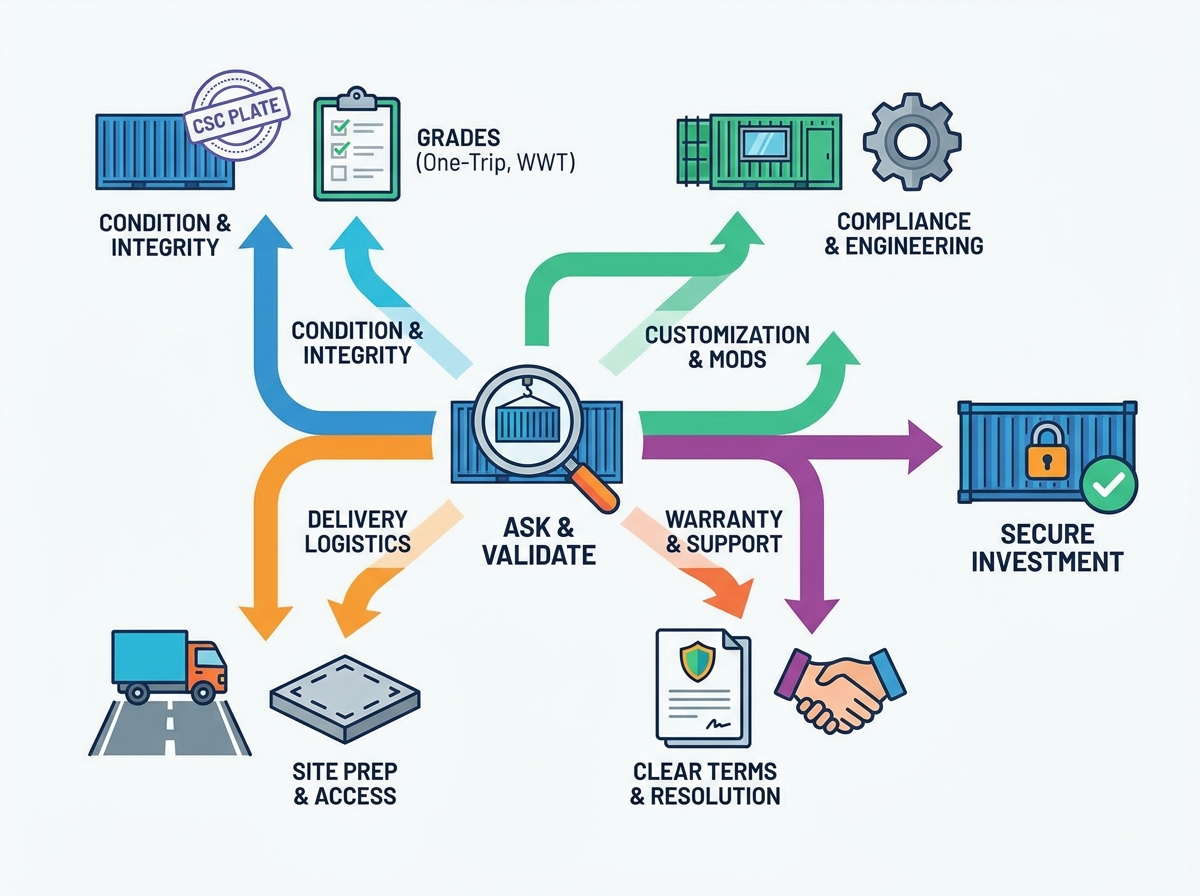
Always verify exact condition grading standards (e.g., One-Trip vs. WWT) and demand proof of structural integrity, such as a valid CSC plate.
Total cost of ownership extends far beyond the container; explicit logistical planning and delivery fees must be formalized upfront.
If requesting modifications, ensure the manufacturer guarantees compliance with local zoning or international shipping codes.
A credible vendor will offer transparent, legally binding warranties covering structural defects and leakages, with clear resolution protocols.
You must clarify exact condition standards before purchasing any unit. Buyers often confuse industry grading terms. Ask the manufacturer to define their specific quality criteria. Condition grades dictate both pricing and long-term viability.
One-Trip: These units are essentially new. They make a single cargo trip across the ocean before arriving at the depot. They feature pristine paint, intact floors, and minimal dents.
Cargo Worthy (CW): These units remain structurally sound for overseas shipping. They show visible wear, surface rust, and dents. However, they pass strict maritime inspections.
Wind and Water Tight (WWT): These containers keep rain and pests out. They can no longer ship freight globally. They serve perfectly for static, on-site storage.
As-Is: These units feature heavy wear, rust, or even structural holes. Buy these entirely at your own risk. They require significant repairs before use.
Next, you must ask about the Container Safety Convention (CSC) plate. Does the unit hold an active CSC plate? This metal plate proves rigorous structural integrity. You absolutely need it if you plan to move freight domestically or internationally. Static storage projects benefit from this verification too. An active CSC plate ensures the unit handles heavy internal loads safely. It guarantees the roof and corner castings remain solid.
Finally, verify the pest and chemical history of the unit. Ask the vendor about previous cargo contents. Shipping lines frequently treat original timber flooring to prevent invasive pests. They sometimes use harsh chemicals like methyl bromide. You must ask for eco-friendly or non-toxic treatment records. This step becomes crucial if you use the unit for human habitation. Sensitive storage projects, like food or agricultural equipment, also require clean, chemical-free flooring. Never skip this safety inquiry.
Many buyers need custom doors, windows, or climate control systems. You must assess how the vendor handles these complex modifications. Ask if they perform the work in-house or hire outside subcontractors. In-house modifications drastically reduce your project lead times. They also ensure tighter, more consistent quality control. The team building your unit communicates directly. Outsourcing often introduces communication delays. It increases the risk of inconsistent workmanship.
Code compliance represents another critical evaluation factor. Structural modifications naturally weaken the original corrugated steel. Cutting a large window compromises load-bearing walls. Ask direct questions about engineering and safety standards. Ask: "Can you provide engineered drawings to satisfy local municipal building codes (IBC)?" A reliable vendor easily supplies these necessary documents. They guarantee your modified unit remains safe and legal. They understand wind load and snow load requirements.
Evaluate material quality carefully during your vendor discussions. Ask about the specific grade of steel used for structural reinforcements. Request details on their chosen weatherproofing techniques. High-quality marine-grade paint prevents premature rusting on new weld seams. Cheap commercial paint peels quickly. It exposes the bare metal to rapid corrosion. Ask the manufacturer to list their specific materials directly in your contract.
Modification Approach Comparison Matrix
Approach | Lead Time Impact | Quality Control | Cost Predictability |
|---|---|---|---|
In-House Operations | Shorter (Direct management) | High (Standardized processes) | Stable (No middleman markups) |
Outsourced / Subcontracted | Longer (Scheduling conflicts) | Variable (Depends on external vendor) | Fluctuating (Subject to third-party pricing) |
Fulfillment logistics require careful and precise planning. Ask what type of heavy equipment will deliver the unit. Tilt-bed trucks slide the container directly into place. They do not require a crane. Flatbed trucks require a heavy-duty forklift or crane on-site to unload. You must confirm the exact turning radius needed for the delivery truck. Ask about overhead clearance requirements. Low-hanging tree branches and power lines frequently disrupt deliveries. Clear these obstacles before the truck arrives.
Site readiness prevents long-term structural and operational issues. Ask the vendor about specific foundation requirements. Units placed directly on soft soil settle unevenly over time. Uneven settling warps the steel frame. It eventually jams the heavy cargo doors. Concrete pads provide the best long-term stability. Railroad ties or compacted gravel beds work very well for temporary placements. They elevate the unit and ensure proper drainage.
Expose hidden fulfillment fees early in the negotiation process. Initial delivery quotes sometimes exclude essential logistical costs. Ask specific questions to avoid frustrating surprises later.
Are there specialized drop fees for complex or tight placements?
Do you charge excessive mileage overages beyond a certain geographic radius?
What are the specific penalty fees if the site is not ready upon arrival?
A trustworthy shipping container manufacturer clearly itemizes these delivery costs upfront. They review your site access via satellite imagery or photos before dispatching trucks.
Explicit warranty terms protect your long-term capital investment. Ask the vendor to separate their coverage types clearly. Structural warranties typically last five to ten years. These cover frame integrity, major rust degradation, and floor rot. Leak and door seal warranties usually last only one to two years. Gaskets degrade naturally over time. Ask for all these specific terms in writing. Verbal assurances hold no legal weight.
Dispute resolution protocols must be absolutely clear. Sometimes a container arrives damaged during transit. What happens if it fails to meet the agreed-upon condition grade? Ask who bears the cost of return freight. You should never pay to return a defective or misrepresented unit. Clarify the inspection timeline upon delivery. Know exactly how many days you have to report hidden damages.
Temporary projects require smart, predefined exit strategies. Ask if the vendor offers a guaranteed buy-back program. Find out exactly how they calculate depreciation on the asset. Pre-negotiating a buy-back percentage saves significant money later. It simplifies site cleanup when your construction or storage project concludes. You avoid the hassle of finding a private buyer.
Watch closely for red flags during your evaluation phase. Some vendors flatly refuse to allow physical yard inspections. Others lack transparent, published pricing structures. Pressuring you for a wire transfer without providing a formal invoice signals a severe scam. Legitimate companies accept standard corporate payment methods. Walk away immediately from vendors exhibiting these suspicious behaviors.
Use a consistent framework to evaluate two or three shortlisted vendors side-by-side. Do not rely on gut feelings. Compare their promised lead times for both delivery and custom modifications. Evaluate the final landed cost. This cost must include taxes, delivery fees, and modification materials. Assess the overall strength and clarity of their written warranties.
Finally, request a complete, itemized quote before committing any funds. This quote must act as a legally binding document. It should separate the base container price from the modification costs. Ensure it clearly lists delivery fees and applicable local taxes. A professional shipping container manufacturer provides comprehensive, detailed paperwork. This robust documentation protects both parties throughout the entire transaction.
Asking the right questions shifts the purchasing power back to you. It ensures your newly acquired asset perfectly matches your strict operational requirements. You eliminate surprise fees and logistical nightmares by demanding absolute clarity upfront. Secure binding warranties to protect your initial capital investment.
Verify structural integrity to maintain a safe, compliant working environment. Do not settle for vague answers regarding condition grades or delivery methods. Take control of your procurement process today.
Reach out to a certified vendor for a transparent, consultative quote. Download a comprehensive buyer’s checklist to guide your conversations. Make your next container purchase a seamless, highly secure investment.
A: A broker acts strictly as a middleman. They do not own the inventory physically. They source units from various depots and add a margin. A manufacturer physically builds or owns the inventory outright. They control the custom modification process directly. Buying from a manufacturer ensures better accountability, superior quality control, and clearer communication.
A: Yes, you should always inspect the exact unit. Reputable vendors provide recent photos before shipping. They also supply the specific serial number of your chosen container. If you cannot visit the physical yard, request a live video walkthrough. This confirms the actual condition matches your agreed-upon contract.
A: Delivery timelines vary based on modification complexity. Standard raw units typically arrive in three to seven days. Custom-modified units require significantly more time. Expect a four to eight-week lead time for doors, windows, or insulation installations. Always secure a guaranteed delivery date in your final written contract.
A: Permit requirements depend heavily on your local municipal zoning laws. Temporary placements often require minimal paperwork. Permanent structures usually demand a full building permit. Check your local codes regarding property setbacks and aesthetic rules. Homeowner associations (HOAs) also have strict regulations often prohibiting large steel structures entirely.


